Search
Thursday, July 02, 2009 ..:: Home ::.. Register  Login
 Forum Minimize

Please visit our forum for Bukit Lawang discussions.


 Print   
 Links Minimize

 Print   
 Bukit Lawang travelogues Minimize

 Print   
 Chat Minimize
Insert EmoticonBoldItalicUnderlineSizeHyperlinkSubscriptSuperscriptColor

 Print   
 Online Users Minimize
Membership Membership:
Latest New User Latest: db
New Today New Today: 0
New Yesterday New Yesterday: 0
User Count Overall: 44

People Online People Online:
Visitors Visitors: 1
Members Members: 0
Total Total: 1

Online Now Online Now:

 Print   
 Welcome To BukitLawang.com Minimize

Welcome to BukitLawang.com. Providing information on tourism and visits to Bukit Lawang, Sumatra, Indonesia.

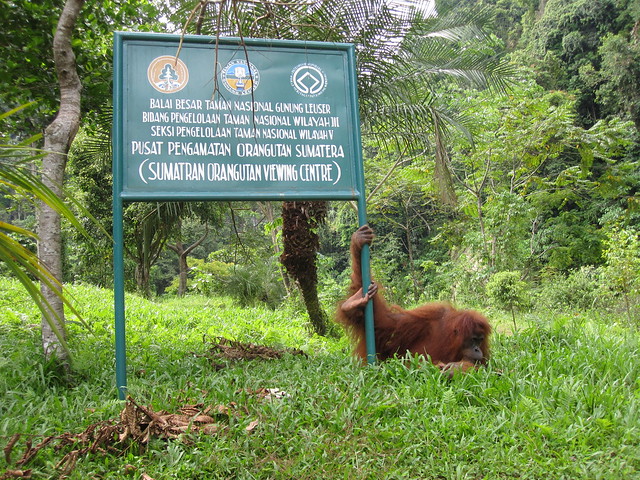
Bukit Lawang is a popular tourist destination for its laidback riverside lifestyle, jungle treks in the Gunung Leuser National Park, and its world-famous orangutan rehabilitation centre..


Syndicate   Print   
 Getting There Minimize

Location

Bukit Lawang is located 86km from Medan, the largest city in Indonesia's Northern island of Sumatra, at the entrance to Gunung Leuser National Park, the last sanctuary of the Sumatran orangutan.

Getting there from Medan

In order to reach Bukit Lawang, tourists can either:

  • take a taxi direct from Medan city centre or airport to Bukit Lawang (about $25)
  • hail a becak (motorised rickshaw) or taxi (about $4), or a local yellow bus (about $0.20) to Pinang Baris station; from there large orange buses travel to Bukit Lawang for approx $0.50, or faster minibuses for $1. Buses run until roughly 5:30pm.
  • take a bus or taxi to Binjai, about 15km from Medan on the road to Bukit Lawang, where minibuses continue until around 6:30pm

Getting to Medan

As Medan is at the top of Indonesia it is a natural first step in an Indonesian trip. Most international visitors arrive from either Singapore, Penang, or Kuala Lumpur, Malaysia. For flights routed to Medan from Europe and the USA, either Singapore or Malaysia Airlines will provide through tickets with a change in Singapore/Kuala Lumpur. To Australia, the Indonesian airline Garuda is the third carrier.

The full list of international destinations is:

Malaysia
Ipoh:
Kartika Airlines (twice weekly), Riau Airlines
Johor Bahru (across the causeway from Singapore in Malaysia): AirAsia, Malaysia Airlines
Penang: Malaysia Airlines, AirAsia,
Lion Air
Kuala Lumpur: Air Asia, Malaysia Airlines

Singapore: Singapore Airlines/
SilkAir (codeshare with Garuda), Valuair

Flights to Chennai (Madras), India are due to start on Garuda Indonesia in June or July 2008.

Access from Penang via high-speed ferry to Medan's port of Belawan is also an option, though the flight is a better option and may only cost $20 more.

The SilkAir Singapore - Medan flight is usually the most expensive, and the short and competitive Penang-Medan fare the cheapest. It can be difficult to book tickets on the Indonesian budget airlines online: a local travelagent is preferred, however, Valuair and AirAsia are good for online bookings.

Within Indonesia, the main route is to Jakarta: the route to Banda Aceh (for Aceh and Pulau Weh), busier due to post-tsunami reconstruction is also well-served.

Other domestic routes include:

Gunung Sitoli (Pulau Nias)
Batam (Riau)
Padang (West Sumatra)
Palembang (South Sumatra)
Pekanbaru (Riau)

The domestic airlines serving Medan are Batavia Air, AirAsia, Garuda, Kartika Airlines, Lion Air, Wings Air, Mandala, Merpati, and Sriwijaya Air; you are advised to consult a local travel agent for bookings.

The main tourist destinations near Medan aside from Bukit Lawang, are Berastagi, a hill-station, and Danau Toba, the world's largest voclanic lake. Both Berastagi and Bukit Lawang are generally visited as a return trip from Medan, although it is possible to arrange to take a tourist bus or charter a bus between the two towns to cut out the stay in Medan. Danau Toba is a little further afield: a tourist bus/charter can be arranged from Bukit Lawang, or from Medan itself, about a five-hour journey. A slightly cheaper option is to take the local bus from Amplas bus station, Medan.

All will drop off in Tuk Ton the shores of Lake Toba, for a ferry across. From Lake Toba, travellers will either double back to Medan for an onward or homeward flight, take a six-hour bus journey to Sibolga, the port for Pulau Nias (which is then an 8 hour ferry journey), or continue on by bus to Bukittinggi (which offers cool air, and Danau Maninjau, another lake), a 12-hour journey (longer in slower, cheaper buses). Travelling by bus back to Medan and flying onto Padang, near to Bukittinggi, or to Gunung Sitoli (on Nias itself) would  be a slightly shorter and more comfortable journey, albeit more expensive. From Bukittinggi, most people will take the long bus journey to Java, or fly onto Jakarta.


 Print   
 Hotels and Guesthouses in Bukit Lawang Minimize

The current accommodation options in Bukit Lawang are in two main areas - on the left bank of the River Bohorok near the Village Entrance, and on the right bank, near the Feeding Centre

Near the Village Entrance, across the river:

  • Wisma Leuser Sibayak, located immediately across the river
  • Bukit Lawang Cottages Eco-Lodge, operated by Paneco, across the river
  • Batu Mandi, across the river, on higher ground, a short walk on the path towards the bat cave
  • Rindu Alam, across the river, further downstream of the village
  • Yusman, upstream of Wisma Leuser Sibayak
  • Bukit Lawang Indah, also just upstream of Wisma Leuser Sibayak

Towards the Orangutan Feeding Area, 10 minutes walk along the right bank of the river

  • Jungle Inn. Telephone: +62 813 7073 0151
  • Sam's Bungalows. Three rooms, Telephone +62 81370093597
  • Garden Inn
  • Indra Inn
  • Rain Forest. Operated by Nora, formerly of Rain Forest Cafe.

Most of these, except for Sam's Bungalows, operated in Bukit Lawang before the flood; many of the other hotels that you may find in old guidebooks are not open any more.


 Print   
 Bukit Lawang flood Minimize

A major flood tragically hit Bukit Lawang in 2003 (see BBC News report). A third of the population of the village was killed. The Bukit Lawang Trust is working to support those orphaned and made destitute by the flood. They have built a hospital to provide access to healthcare for people in the village.

As the people of Bukit Lawang are almost 100% dependent on tourism for income, they have worked to rebuild the village, and as of 2008 numerous accommodation options and restaurants are available, as well as trekking and tour guides. The orangutans were less affected by the flood than the human population as they were mostly on higher ground.


 Print   
Copyright 2008, BukitLawang.com   Terms Of Use  Privacy Statement